Photography and video are a big part of our everyday life. We use them to document our travels, capture the places and experiences we discover, and create professional content for brands and other projects. For Shams, it’s also his job. He works as a photographer, videographer and drone pilot, so our gear needs to work for both adventure and professional productions. We don’t take everything with us every time. We choose our gear depending on the adventure, the location and the images we want to create. Here’s what we use most.
Sony A7C II: Our Main Camera
The Sony A7C II is our main camera. It’s compact enough to take on outdoor adventures while still delivering the image quality we need for professional work. It’s our starting point, with different lenses depending on what we’re shooting.
21mm Wide-Angle: For Big Landscapes
Our 21mm wide-angle lens is one of our favourites for landscapes. It’s perfect for mountains, coastlines, forests and wide-open spaces, especially when we want to show the scale of a place. We also love using it for night photography and the Milky Way, where the sky becomes part of the story.
Lien reference
100–400mm: For Wildlife and Distant Subjects
The 100–400mm telephoto lens is our go-to when things are far away. It’s especially useful for wildlife, where getting closer isn’t always possible. It’s also great for isolating details in a landscape, compressing distant mountains or capturing a different perspective.
Lien ref
24–70mm: The All-Rounder
The 24–70mm is our most versatile lens. When we’re not sure what we’ll encounter, it gives us the flexibility to shoot landscapes, portraits, details and everyday moments without constantly changing lenses. Sometimes, having one lens that can do almost everything is exactly what we need.
Lien reference
Night Photography
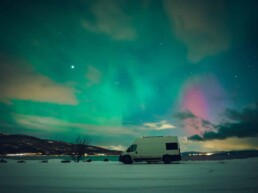
We particularly enjoy shooting at night. Once the sun goes down, familiar landscapes completely change, and the sky becomes a huge part of the image. Our 21mm is ideal for this, especially when shooting the Milky Way. It takes a little patience, but when everything lines up, the results can be magical.
Tripod: Essential for Night Photography
A tripod is essential for some of our shots, especially at night. We use a Manfrotto 290 for night photography, long exposures and shooting the Milky Way. It’s solid and stable, but also quite heavy for long hikes.
https://link.amazon/B04mNxyzg
When we want to travel light, we take a small Gorillapod-style tripod instead. It’s compact, easy to carry and can be attached to different surfaces.The right tripod simply depends on the adventure.
https://link.amazon/B0cYcaoBz
ND Filters
We also use ND filters, mainly for video. They help us control the amount of light entering the lens and give us more control over our camera settings. They’re also useful for certain long-exposure shots during the day.
Photos/references liens
Drones: A Different Perspective
Drone photography and video are also part of Shams’ work. We use a DJI Avata and a DJI Mini, depending on the project.
DJI Avata
The Avata is our choice for FPV shots.
It allows us to create more immersive and dynamic sequences, moving through landscapes rather than simply filming them from above.
https://link.amazon/B0a07pKpf
DJI Air 3S
The DJI Air 3 is more suited to traditional aerial shots.
It’s great for revealing a landscape from above and showing a place from a completely different perspective.
https://link.amazon/B07Lp7fjZ
DJI Osmo 360: For Life on the Move
The DJI Osmo 360 is our go-to when we’re moving. It’s quick, simple and perfect for hikes, paragliding, ski, all other activities and spontaneous moments where taking out a camera would be too much hassle. Sometimes, you just want to press record and keep going. A 360° camera gives us much more freedom when filming. Instead of choosing the perfect angle beforehand, we can capture everything around us and decide on the framing later. It’s especially fun for travel and outdoor adventures, where the environment is such a big part of the story.
https://link.amazon/B00llKATq
Insta360 X5: Another Way to Capture the Moment
We also use the Insta360 X5. They give us a completely different way of filming, with 360° capture that lets us choose the framing later. They’re great for travel and outdoor adventures, especially when we want to capture the whole experience rather than just one angle.
https://link.amazon/B01FLhzqc
Insta360 GO Ultra: Small and Spontaneous
The Insta360 GO Ultra is tiny, which is exactly why we love it. It’s great for POV shots, hands-free filming and moments we want to capture without carrying a bigger camera. Sometimes, the simplest shots are the ones that make a video feel the most real.
https://link.amazon/B0h1rP7ui
Another Way to Capture the Moment
We also use the Insta360 X4 and X5, along with various Insta360 selfie sticks depending on the effect we want. Different lengths give us different possibilities, from the 1.14 m stick for everyday shots to the 3 m stick when we want that invisible-stick, “no drone, no problem” effect. We also use them for Bullet Time and other creative shots. They’re a great way to get more creative with our 360° footage without carrying a lot of extra gear.
https://link.amazon/B0fXGLquf
https://link.amazon/B0abE6VnH
https://link.amazon/B08c3O3If
https://link.amazon/B0f0p9NBL
Capture clip
The Peak Design Capture Clip keeps your camera securely attached to your backpack strap, making it quick and easy to access while hiking or travelling. It’s sturdy, compact and perfect for keeping your camera close without having to carry it around your neck.
https://link.amazon/B0gZHeOqH
Choosing the Right Gear
Having all this gear doesn’t mean we take everything everywhere. We choose what we need depending on what we’re doing. A landscape hike, a wildlife outing and a professional video shoot all require very different setups. That’s the real advantage of having different tools: we can take the right one for the moment.